Do UK Small Businesses Actually Need a New Website in 2026?
Quick Summary:
UK small businesses do not automatically need brand-new websites in 2026. The right decision depends on whether the current site is mobile-friendly, fast, secure, and converting visitors effectively, with targeted improvements often delivering better ROI than full rebuilds.
Estimated reading time: 9 minutes
“Should I build a completely new website?” This question confronts nearly every UK small business owner at some point, particularly when competitors launch sleek new sites or when reading articles about the latest web design trends.
The honest answer? Probably not—at least not yet.
The reality about websites in 2026 is that shiny new designs rarely solve the actual problems holding businesses back. I’ve watched UK SMEs invest £5,000–£15,000 in complete website rebuilds only to see identical conversion rates, bounce rates, and customer enquiries as their previous site delivered.
The businesses achieving breakthrough results aren’t necessarily those with the newest websites—they’re the ones whose websites function properly for their specific business goals, regardless of launch date.
Let me help you determine whether your business genuinely needs a new website, or whether strategic improvements to your existing site would deliver better returns for substantially less investment.
The Reality Check: Why Most UK SMEs Consider New Websites
According to research from 2025, most UK businesses invested in web design, with over half either creating new websites or significantly improving existing ones. This significant market activity creates pressure—when competitors launch modern sites, yours suddenly feels out-dated by comparison.
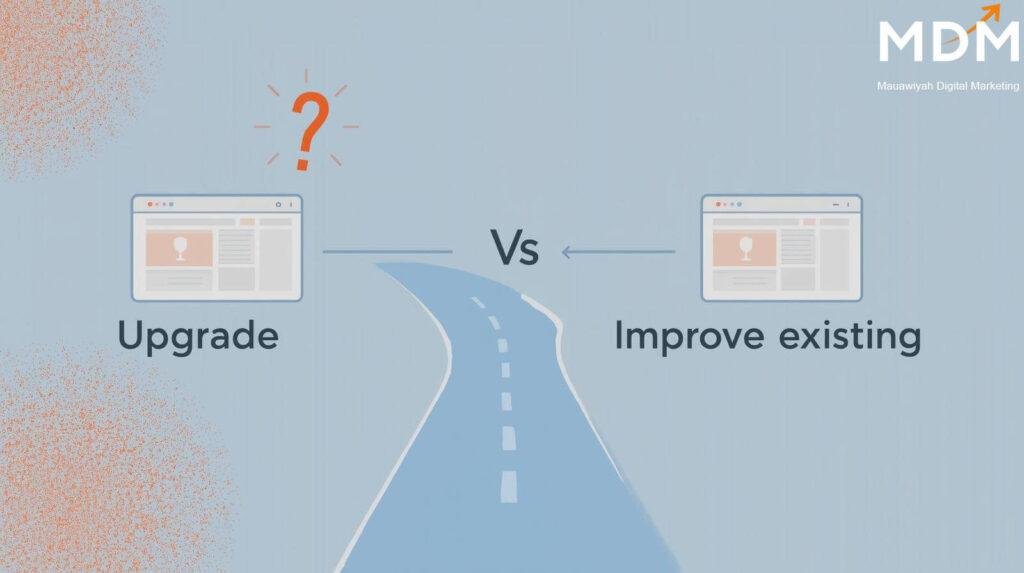
However, these statistics reveal something critical: nearly half of businesses investing in web design are improving existing sites rather than building from scratch. They’ve recognised that strategic enhancements often deliver equal or better results at fraction the cost of complete rebuilds.
With most small businesses now having websites, the competitive differentiator has shifted from merely having an online presence to ensuring your website performs its intended function effectively. Superior execution and ongoing optimisation matter exponentially more than aesthetic appeal.
When You Genuinely Need a New Website
Certain situations legitimately warrant complete website rebuilds rather than incremental improvements:
Your Current Website Isn’t Mobile-Functional
Mobile devices account for over half of UK web traffic, with near-universal smartphone ownership among UK adults. If your website requires pinch-and-zoom to read text, has buttons too small for thumb-tapping, or elements that overlap on smaller screens, you’re losing most potential customers immediately.
“Responsive design” became standard practice years ago. If your website predates 2018 and hasn’t been meaningfully updated, it is likely to fall short of modern mobile requirements. This isn’t fixable through minor tweaks—it requires rebuilding with mobile-first principles.
Test your site honestly: load it on your smartphone using mobile data (not office WiFi). Navigate exactly as customers would. Can you easily find contact information, understand services offered, and complete your primary call-to-action? If not, you need a new website.
Your Website Is Dangerously Slow
Page speed directly impacts conversions. Research shows that most mobile users abandon sites taking longer than three seconds to load. Google’s Core Web Vitals now influence search rankings substantially, meaning slow websites become progressively invisible as competitors with faster sites climb above you.
Test your website using Google PageSpeed Insights. If your mobile performance score sits below 50, you have critical performance issues. Scores between 50-80 indicate opportunities for improvement. Only scores above 80 suggest adequately optimised performance.
Sometimes speed issues stem from fixable problems—oversized images, unnecessary plugins, poor hosting. However, if your website runs on outdated platforms with bloated code that can’t be optimised effectively, rebuilding on modern infrastructure often proves the only solution.
You Can’t Update Content Yourself
If changing a paragraph on your website requires contacting your web developer and waiting three weeks whilst paying £200 for the privilege, your website architecture fails fundamental requirements.
Modern content management systems such as WordPress, Squarespace, Wix, and Shopify allow non-technical business owners to update text, add photographs, create new pages, and manage content independently. If your website was custom-coded in outdated languages requiring specialist knowledge for every minor change, you’re hamstrung operationally.
This particularly matters for businesses needing regular content updates—restaurants changing menus, service businesses adding new offerings, retailers featuring seasonal products. Static websites requiring developer intervention for every change aren’t viable in 2026.
Your Website Isn’t Secure
Security matters more in 2026 than ever before. Websites without SSL certificates (indicated by “https://” rather than “http://”) trigger browser warnings that immediately destroy trust. Google penalises non-secure sites in search rankings.
Beyond SSL, outdated platforms with unpatched security vulnerabilities expose your business to genuine risk—hackers exploit these weaknesses to inject malicious code, steal customer data, or crash websites entirely.
If your website runs on abandoned platforms no longer receiving security updates, rebuilding on actively maintained, secure infrastructure isn’t optional—it’s necessary to protect both your business and customers.
Your Business Has Fundamentally Changed
Websites should reflect what businesses actually do. If you launched with three services five years ago and now offer fifteen different solutions, yet your website still promotes those original three, it’s actively misrepresenting your business to potential customers.
Similarly, businesses pivoting significantly—solicitors adding mediation services, accountants launching business consulting, retailers moving from physical to e-commerce focus—may find their existing website architecture can’t adapt to showcase the new direction properly.
However, even major business changes don’t automatically necessitate complete rebuilds. Evaluate whether your current website’s structure can accommodate new content and offerings with modifications before assuming you need to start from scratch.
When You Don’t Need a New Website
Most UK small business owners contemplating new websites don’t actually require them. They need specific improvements addressing particular weaknesses.
“Our Website Looks Outdated”
Unless your website genuinely resembles 1990s design with bright backgrounds, Comic Sans text, and animated GIFs, “outdated” is subjective. A website from 2020 with clean design, proper functionality, and quality content doesn’t need rebuilding simply because 2026 design trends favour different typography or colour schemes.
Aesthetic updates are achievable without rebuilding entire websites. Refreshing colour palettes, updating typography, replacing outdated photographs with current images, and modernising button styles can dramatically improve visual appeal whilst retaining functional infrastructure.
Before spending £10,000 rebuilding because your website ‘looks old’, invest £1,000–£2,000 in professional design updates to existing assets. You’ll be surprised how transformative these focused improvements prove.
“Our Competitors Have Newer Sites”
Your customers don’t compare your website to competitors’ sites—they evaluate whether yours provides information they need to make informed decisions.
A well-structured website with comprehensive content, fast loading, mobile functionality, and clear calls-to-action outperforms a visually stunning but functionally poor website every time. Competitors spending £15,000 on flashy redesigns whilst neglecting content strategy, SEO, and conversion optimisation are wasting money.
Focus on whether your website serves customers effectively, not whether it matches competitors’ aesthetic choices.
“We’re Not Getting Enough Enquiries”
Low conversion rates rarely stem from website design—they indicate deeper problems with targeting, messaging, value proposition, trust signals, or competitive positioning.
A complete rebuild won’t fix unclear messaging about who you serve and why they should choose you. It won’t address inadequate trust signals (no reviews, no credentials, no testimonials). It won’t compensate for pricing misalignment or services customers don’t actually want.
Before rebuilding your website hoping for better results, honestly assess:
- Is your website attracting the right visitors? (If not, your marketing/SEO needs work, not your website)
- Do visitors understand immediately what you offer and who it’s for? (If not, improve messaging, don’t rebuild)
- Do you provide compelling reasons why visitors should choose you specifically? (If not, strengthen value proposition and trust signals)
- Is your call-to-action obvious and compelling? (If not, improve CTA design and copy)
Most businesses discovering their website “doesn’t generate enquiries” find the actual problem lies in these strategic areas rather than technical website structure.
“We Want to Add [Single Feature]”
“We need a new website because we want to add online booking” or “…because we need a blog” or “…because we want video content” almost never justifies complete rebuilds.
Modern content management systems allow adding functionality through plugins and integrations. Booking systems, e-commerce capabilities, membership areas, blogs, email capture forms—these features integrate into existing websites without rebuilding everything.
If your current platform genuinely can’t accommodate new features, evaluate migration rather than complete redesign. Preserving content, SEO value, and functionality whilst shifting to more flexible platforms often proves more cost-effective than starting fresh.
The Cost Reality: New vs. Improved
UK small business website projects range dramatically in cost depending on approach:
Complete rebuild with professional agency: £5,000-£25,000+ depending on complexity, custom features, and ongoing support requirements.
DIY platforms (such as Wix, Squarespace, or WordPress with premium themes): £500-£2,000 initial setup including premium themes, plugins, and your time investment, plus £10-£50 monthly hosting/subscriptions.
Strategic improvements to existing website: £1,000-£5,000 covering content updates, design refreshes, speed optimisation, mobile improvements, and specific functionality additions.
For most UK small businesses, strategic improvements to existing websites deliver 60-80% of new website benefits at 20-30% of the cost. Unless facing genuinely insurmountable problems (security vulnerabilities, complete mobile failure, impossible-to-update architecture), this represents far better return on investment.
The Strategic Improvement Approach
Rather than rebuilding entirely, systematically address your website’s specific weaknesses through the following steps:
Audit Current Performance: Use Google Analytics to identify where visitors leave your site, which pages convert well, and which fail completely. Google PageSpeed Insights reveals technical performance issues. Real user testing (watching people navigate your site) exposes usability problems.
Prioritise Highest-Impact Improvements: Fix mobile functionality first—this affects more than half your visitors. Address speed issues next. Then tackle conversion optimisation (improved calls-to-action, better trust signals, clearer value propositions).
Improve Content Strategically: Outdated photographs, thin service descriptions, and generic “about us” text undermine effectiveness far more than design aesthetics. Comprehensive, helpful content demonstrating expertise consistently outperforms shallow content wrapped in modern design.
Add Missing Functionality: Integrate necessary features like online booking, e-commerce capabilities, or lead capture forms through plugins and platforms rather than rebuilding everything.
Update Visual Elements Selectively: Refresh typography, update colour schemes, replace outdated images, and modernise buttons—all achievable without structural rebuilds.
This systematic approach allows spreading improvements across several months, measuring impact incrementally, and investing only in changes that demonstrably improve results.
The Decision Framework
Ask yourself these questions honestly:
Does my website load properly on mobile devices? Test it now on your smartphone.
Does it load within three seconds? (Check PageSpeed Insights)
Can I update content independently? (Try changing a paragraph without developer assistance)
Is it secure with SSL certificates? (Look for “https://” in your URL)
Does it accurately represent my current business offerings?
Can visitors easily find contact information and understand what I do?
Does it rank reasonably well for relevant searches? (Check where you appear for your primary keywords)
If you answered “no” to one or two questions, strategic improvements likely suffice. If you answered “no” to three or more, particularly mobile functionality, speed, or security, you genuinely need either substantial reconstruction or complete rebuilding.
The Reality for Most UK SMEs
The vast majority of UK small businesses considering new websites would achieve better results investing in strategic improvements to existing sites, supported by enhanced content marketing, proper SEO, and conversion optimisation.
Complete rebuilds make sense when websites fundamentally fail to function—but “function” means loading properly on mobile, loading quickly, remaining secure, and allowing content updates. It doesn’t mean matching 2026 design trends or looking like competitors.
Your website exists to serve business objectives: generating enquiries, enabling bookings, facilitating sales, building trust. If it achieves these objectives adequately, improving specific weaknesses delivers far better return than rebuilding entirely.
The businesses thriving online in 2026 aren’t necessarily those with the newest websites—they’re those whose websites work effectively for their specific business model, regardless of launch date.
About the Author
Dr Mauawiyah Hussan holds a Doctorate in Business Administration (DBA) and is the founder of Mauawiyah Digital Marketing. Based in Dudley, he specialises in helping small and medium-sized businesses across the West Midlands improve their online visibility and decision-making through evidence-based digital marketing strategies. With a focus on strategic insight and measurable outcomes, Dr Mauawiyah works directly with local SMEs throughout Dudley, Birmingham, Wolverhampton, the Black Country and the wider West Midlands region to develop practical, results-driven marketing solutions that support sustainable growth.
If your website needs improvement in structure, usability, or performance, Dr Mauawiyah provides website design and development services focused on clarity, speed, and conversion rather than visual trends alone.
To understand Dr Mauawiyah’s broader approach to digital marketing and how it supports sustainable business growth, visit the Mauawiyah Digital Marketing homepage, where strategy, clarity, and performance are central to every engagement.
If you would like tailored guidance based on your business goals and current challenges, you can book a free consultation to discuss practical next steps and determine whether a structured digital strategy is right for your business. Consultations are available for businesses across Dudley, Birmingham, Wolverhampton, and the wider West Midlands region.
If this raised questions for your business, feel free to message us on WhatsApp.
For further insights and industry updates, explore our blog